

2.5 Hours to 11 Minutes, 60,000 Transcripts at 98%, 17 Models Under One Roof: Inside UC San Diego’s Build-It-Yourself AI Strategy
In our latest Use Case Lab, UCSD’s Brett Pollak walked through what an in-house AI strategy actually produces — the wins with real numbers, the projects they killed, and the one principle holding it t

Most AI-in-higher-ed stories are about buying something. This one is about a university that kept deciding, over and over, to build instead — and can tell you to the minute what that decision bought them.
Brett Pollak is Executive Director of IT Services at UC San Diego, which runs a supercomputer center next door to his team and serves more than 40,000 students and 38,000 staff across campus and health sciences. In our latest Use Case Lab, he opened the box on TritonGPT and the wider Triton AI portfolio — and what makes his account worth your time is not the technology. It’s that he brought receipts, named the failures, and was refreshingly clear about the one bet the whole strategy rests on.
The Numbers He Brought
UCSD’s AI work started in 2023 on the administrative side, not the classroom — a deliberate choice, because administration was where they could move fast and measure hard. A cross-functional group paired IT with the university’s operational-strategy team (Lean Six Sigma black belts, of all things) to hunt for manual, high-volume work ripe for automation. Two results tell the story better than any capability list.
Contract review: an automated red-lining tool took a first-pass contract review from about two and a half hours of a legal expert’s time down to roughly 11 minutes — with a human still in the loop, checking the red-lines before anything moves. The contract is emailed in; a marked-up version comes back.
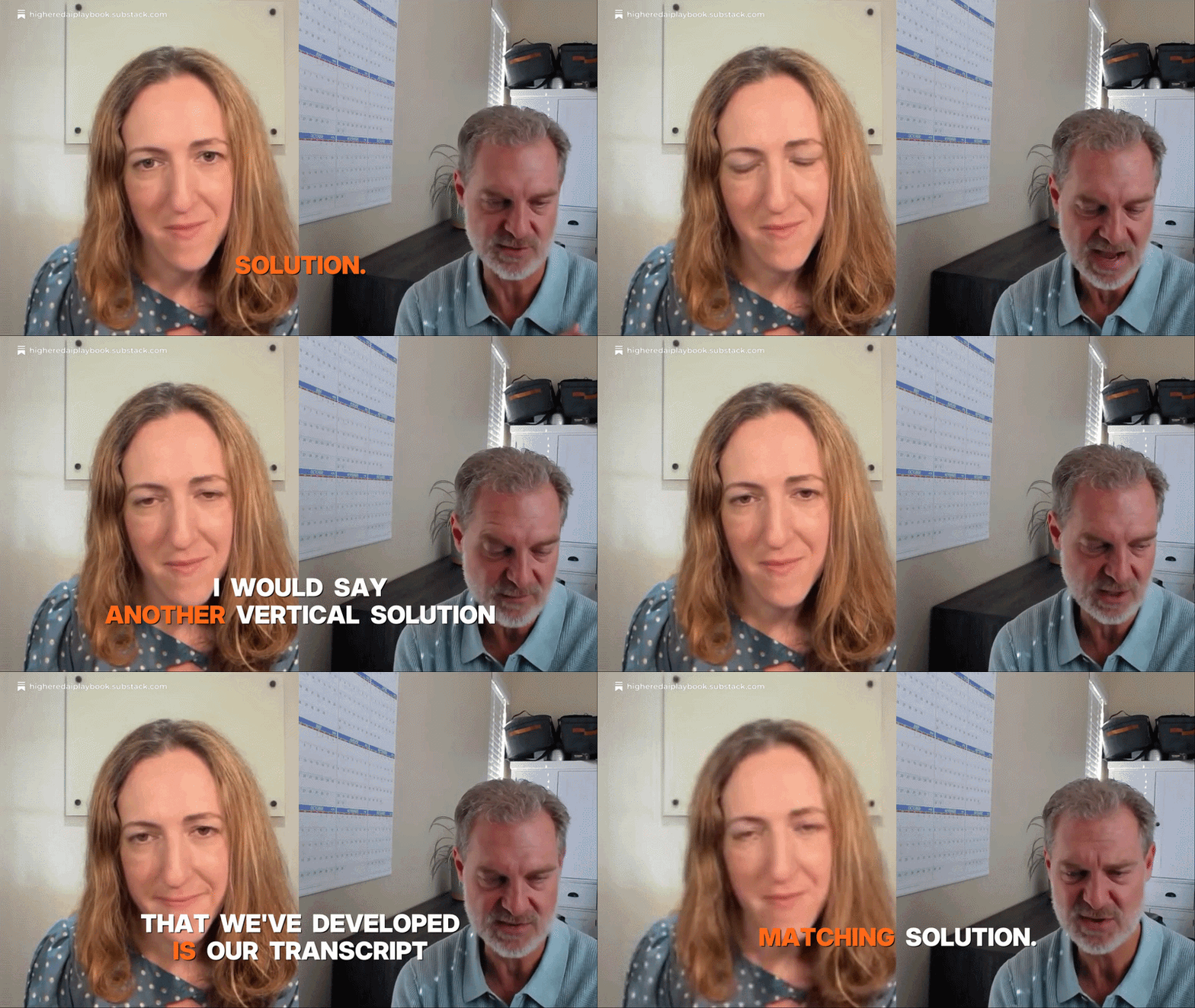
Transcript matching: as one of the most-applied-to universities in the country, UCSD processes about 60,000 transcripts a term, once a manual job requiring months of temp staff. Their solution now matches transcripts to student records at about 98% accuracy, turning a three-to-five-minute-per-transcript task into cost avoidance at scale.
Pollak’s framing on measurement was blunt and correct: “Why do it if you can’t measure it and you’re not seeing value?” That instinct is exactly what separates the deployments that survive a budget review from the ones that quietly disappear. He measured the manual baseline before building, so he could name the delta after.
What TritonGPT Actually Is
TritonGPT is the cornerstone — a ChatGPT-style experience, but every assistant is grounded in UCSD’s own institutional context. The flagship UCSD Assistant draws on roughly 60 curated university websites through a retrieval-augmented architecture, built on an open-source platform called Onyx. And the origin story is the kind of detail that makes the whole thing human: a student working the IT service desk connected the team’s knowledge base to Onyx to answer support calls faster, demoed it at a biweekly experimentation meeting, and — as it happened — Onyx had been founded by two UCSD alumni. UCSD became one of their first enterprise customers.
The ecosystem now runs 20-some assistants, from job-description writers to a financial assistant that lets the CFO’s team query the enterprise data warehouse in natural language and drill into departmental trends conversationally, rather than staring at a static Tableau dashboard. And there are Socratic instructional tutors integrated with Canvas, bound only to a faculty member’s own course content, piloting now with a fuller launch planned for the fall.
The reason any of this could happen is infrastructure most institutions don’t have: UCSD hosts open-source models on-premise at the San Diego Supercomputer Center, next door to Pollak’s team. That gives them, in his words, control over their data and the ability to integrate it without worrying about where it goes — and it lets the community use frontier-class models without paying per-token costs to the major labs. According to UCSD’s public Triton AI hub, TritonGPT now offers a choice of 17 models under one roof — commercial frontier models like GPT-5.5, Claude Opus, and Gemini 3.1 alongside self-hosted open-weight models like Llama 4 and Kimi K2.5 — with users swapping between them in settings, and developers reaching them through a managed gateway. That single detail is the whole strategy made visible: many models, one controlled layer, the institution’s data never leaving a boundary it governs. (The public hub is at tritonai.ucsd.edu.)
The Part Most Recaps Would Skip: What They Killed
Here is what made this conversation more useful than a product tour. I asked Pollak what they’ve had to say no to — and he answered honestly. UCSD tried to build a broad “enter prise data agent” that would let anyone query structured warehouse data in plain English (text-to-SQL). It didn’t work well enough. Interpreting a user’s prompt, mapping it to the right metadata, and pulling the correct row and column back reliably turned out to be genuinely hard — and for enterprise data driving real business decisions, a tolerable hallucination rate is close to zero. So they pulled it back from a broad launch, kept it bespoke on narrow, well-understood data sources, and are now evaluating whether to bring in a vendor product for the general case instead.
That is a governance decision disguised as a technical one, and it’s the tell of a mature program: the willingness to define where AI is not ready, and to stop. His build-versus-buy answer flowed from the same place — “it depends on the use case,” with the honest admission that for some problems, “we could never keep up with a vendor in the space.”
The full Use Case Lab recording — Brett Pollak, unedited — is below, along with the operational lessons: how UCSD governs agent access to data, the build-vs-buy heuristic that keeps them out of trouble, and the one strategic bet the whole portfolio depends on. Paid subscribers get the full session and the lab archive.
Below, for paid subscribers: the four lessons a cabinet can actually use from how UCSD built this — including the agnostic bet, the data-governance model for agents, and the permissions design that stops an agent one toggle short of trouble — plus the full recording.