
How to Build Microcredentials Employers Actually Recognize
Stackable, Badged, and Wired to the Workforce - Without Creating Portfolio Chaos

Issue #5
Last issue we documented the alignment crisis: only 37% of employers say higher ed is preparing students with the skills they need, while 50% are now assessing candidates for AI fluency at the point of hire (WGU Workforce Decoded, 2026). The fix isn’t another general-education tweak. It’s a credential infrastructure question: who issues which badges, what do they signal, and how do they stack into something employers will actually pay attention to?
The case for microcredentials is strong. The risk is portfolio chaos - a thicket of unrecognized certificates students collect with no clear hierarchy, no learning-outcome evidence, and no employer endorsement. This issue is about how to build microcredentials with governance baked in: the kind that survive an accreditation visit and an HR screening at the same time.
These are the numbers from the same WGU survey of 3,147 employers. They aren’t a forecast - they’re the current employer screening posture, already in motion.
The Credential Recognition Gap
Two data points reframe the conversation. From the WGU Workforce Decoded survey: 86% of employers view certificates as valuable indicators of readiness, and 78% say work experience is equal to or more valuable than a degree. Lightcast’s analysis of more than 100 million worker profiles tells the parallel story from the other side: formal education is no longer the sole on-ramp into AI careers. Most workers reach AI roles through nonlinear transitions, self-directed learning, and stackable credentials picked up along the way.
The implication for institutions is uncomfortable. If employers are signaling that bundled four-year degrees aren’t the only - or even the primary - proof of readiness they care about, then the institutions that capture credibility in this market will be the ones that issue meaningful, granular credentials alongside the degree, not in opposition to it.
Federal policy is reinforcing the shift. Workforce Pell takes effect July 1, 2026 and requires 70% completion and 70% job placement for participating short-term programs (U.S. Department of Education). Most current short-term offerings won’t clear that bar, which is exactly the point. And on January 9, 2026, the AHEAD rulemaking concluded with a historic 12-0 consensus vote - what the Department called the most significant accountability shift in three decades. The federal posture is moving from credentialing-as-input to credentialing-as-outcome, and microcredentials sit squarely in the new line of sight.
What ‘Stackable’ Actually Means
Three properties separate a coherent microcredential portfolio from a chaotic one.
Verifiable competency. Each badge is tied to specific learning outcomes that can be assessed and replicated. Purdue set the U.S. bar last fall when its trustees approved an AI working competency as a graduation requirement for every student - not a vague aspiration but a defined standard the IDA+A data science team is accountable to measure against. That’s what verifiability looks like in practice: a named competency, a documented assessment method, and an institutional team responsible for proving the bar got cleared. Without it, a badge is a participation trophy.
Architected stacking. Badges have explicit prerequisite relationships and explicit pathways into degrees, certificates, or job classifications. The Medical University of South Carolina’s competency-based AI literacy framework, grounded in the Digital Education Council AI Literacy Framework, defines a shared progression across awareness, competency, and application. An awareness-level badge in one school maps cleanly onto an application-level requirement in another - which is what ‘stackable’ has to mean if students are going to combine credentials across schools and over time.
Employer-recognized. A badge has portability only if employers in the relevant region say so. Georgetown CSET’s PATHWISE tool maps AI and cybersecurity job demand at the metro level, giving institutions a way to ground credential design in real-time labor-market signals rather than internal assumption. Carnegie Mellon’s Heinz College takes the validation a step further: in its employer-validated capstone program, employer partners sponsor semester-long projects, teams tackle real challenges, and both faculty and the employer evaluate. The credential records what the employer signed off on - not what the syllabus said it should. For institutions wanting an external proficiency scale to anchor against, the University of Manchester’s AI literacy partnership with Multiverse uses the European Digital Competence Framework’s six levels (Newcomer through Pioneer) - a useful comparative reference for U.S. institutions designing their own.
When all three are present, microcredentials stop competing with the degree and start completing it.
Three Programs Worth Studying
University of Hawai’i - AI Foundations Badge. UH launched ‘Artificial Intelligence for Hawai’i’ in March 2026, a free 12-chapter interactive program for the UH ‘ohana and surrounding communities. New chapters release weekly; completion earns an AI Foundations Badge - a digital credential demonstrating foundational AI literacy, ethical practice, and responsible use across the UH system. Two design choices stand out. First, the badge is system-wide, not departmental, which gives it the same brand weight a UH degree carries. Second, it pairs an entry-level credential with a free public on-ramp - the badge becomes the institution’s invitation to non-traditional learners, not just to students already paying tuition.
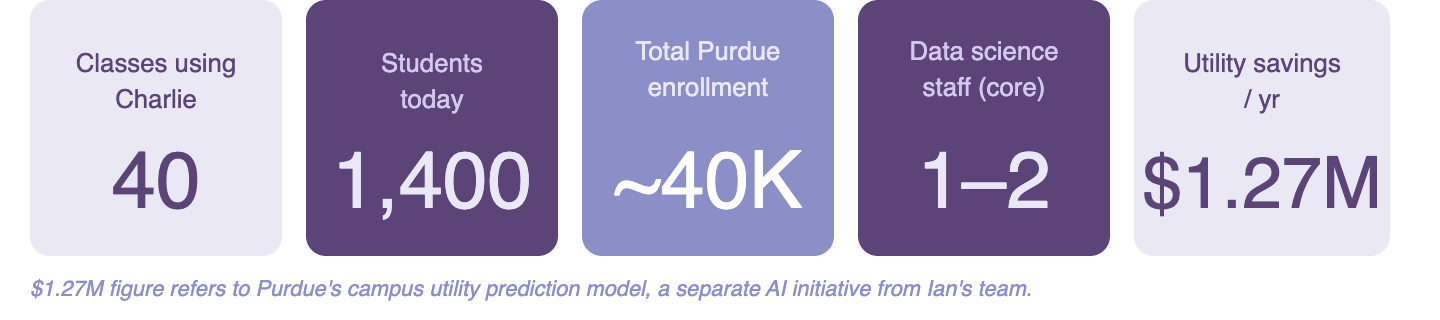
Purdue University - Charlie, AI Writing Feedback Tool. Purdue’s data science team rebuilt a faculty research project into Charlie — an AI writing coach live in 40 classes serving ~1,400 students. It abandoned essay scoring entirely in favor of written coaching feedback only, running GPT-4 via Azure with RAG from course PDFs. Build cost: roughly one full-time data scientist on Purdue’s general budget.
Two choices stand out. First, they built a separate evaluation model, calibrated to a faculty expert’s judgment, that scores Charlie’s feedback quality every time the tool changes. That’s how they caught that RAG improved accuracy but made the tone harsher. They chose accuracy. Most teams wouldn’t have known there was a choice. Second, development is currently paused while the commercial market catches up. Purdue has pre-committed to stepping back if a vendor matches their quality. Knowing when to stop building is as rare as knowing how to start.
Vanderbilt - Multi-Tool Stack with Grow with Google. Vanderbilt has expanded community-wide access to a coordinated multi-tool AI stack: ChatGPT Edu, the Amplify 2.0 platform built in-house, and Grow with Google certificates spanning analytics, project management, UX, cybersecurity, digital marketing, and IT support. Reported adoption: more than 70% of the campus community uses generative AI tools regularly. The lesson is interoperability. Vanderbilt isn’t trying to issue every credential itself; it’s issuing the integration - wrapping vendor certificates, internal platforms, and OpenAI-grade access in a single recognizable institutional package. The university becomes the trust layer over a credential ecosystem its students will keep using long after graduation.
Each of these programs makes a different bet about where institutional value sits - in the badge itself, in the credit-employer co-design, or in the institutional integration of third-party credentials. All three are defensible. What none of them can skip is the governance scaffolding that makes the credential trustworthy.
Governance Moves That Make Microcredentials Stick
Microcredentials fail not because students can’t earn them but because institutions can’t vouch for them. From advising work with university systems, four governance moves separate credentials that travel from credentials that don’t.
1. Define the credential ladder before issuing the first badge. Decide upfront how each microcredential maps to (a) credit and degree progression, (b) external proficiency frameworks (DigComp, Digital Education Council, NIST AI RMF role definitions), and (c) job classifications in your local labor market. Without this map, badges accumulate without composing - which is exactly the chaos employers complain about and accreditors flag.
2. Treat assessment design as a governance artifact, not a course matter. Each badge needs a documented competency definition, an assessment method, an inter-rater reliability target, and a periodic review cadence. Borrow Purdue IDA+A’s discipline of triangulating evaluation across an LLM rater, a human subject-matter expert, and a calibration loop. Defining ‘good’ is hard; credentials live or die on whether your institution can defend that definition under scrutiny.
3. Bring procurement and vendor due diligence into the credential conversation. When the badge runs on a third-party platform - a Coursera Coach, a Multiverse cohort, a Grow with Google certificate - the vendor’s data practices, accessibility posture, and IP terms become institutional liabilities the moment your seal is on the credential. Credential governance needs the same rigor as enterprise procurement: HECVAT-plus-AI annex, FERPA-aligned data tiers, audit logging, and clear language on who owns the verification record if the vendor relationship ends.
4. Publish outcomes data. Workforce Pell will require 70% completion and 70% placement. Don’t wait for the rule to bite - institutions that publish completion-to-placement data on every microcredential build credibility with both employers and accreditors well before the threshold becomes a compliance question. The institutions doing this best treat outcome reporting as a credentialing feature, not a regulatory burden.
What’s Ahead
Issue #6 will turn to AI hiring committees - how institutions are setting up cross-functional review boards for AI-related faculty and staff appointments, what those committees actually evaluate, and how to staff one without creating a bottleneck.
We’ll also start a recurring ‘Use Case of the Month’ feature, anchored to a single validated implementation drawn from the open AI Use Cases handbook.
And we’ll continue tracking federal policy: the AHEAD rulemaking implementation timeline, Workforce Pell program approvals, and where state AI frameworks are landing - Digital Promise’s December 2025 review of 32 states found most still nascent and exploratory, which means the institutions moving now are the ones writing the templates everyone else will eventually adopt.
With gratitude,
Dr. Aviva Legatt
Founder, EdGenerative - Affiliated Faculty, University of Pennsylvania - Forbes Contributor