
Instructure Paid the Ransom. Higher Ed Just Discovered Its Vendor Concentration Problem.
What the Canvas Breach Reveals About the Structural Exposure Senior Leaders Have Quietly Accumulated

Issue #6
On May 11, Instructure confirmed it had paid a ransom to ShinyHunters, the extortion group that twice breached Canvas in nine days, exposed data from approximately 8,809 institutions and 275 million users, and brought the most widely deployed learning management system in North American higher education offline during finals week.
The company said it received “digital confirmation of data destruction (shred logs)” and assurance that no Instructure customers would be extorted. The monetary value was not disclosed. According to Wikipedia’s ongoing accounting of the incident, unconfirmed rumors place the payment at $10 million.
The ransom is the story drawing cybersecurity attention. It is not the story higher ed leaders should be paying attention to.

The Attack Vector Tells the Story
The most consequential detail of the May 2026 Canvas breach is not the ransom payment. It is how ShinyHunters got in.
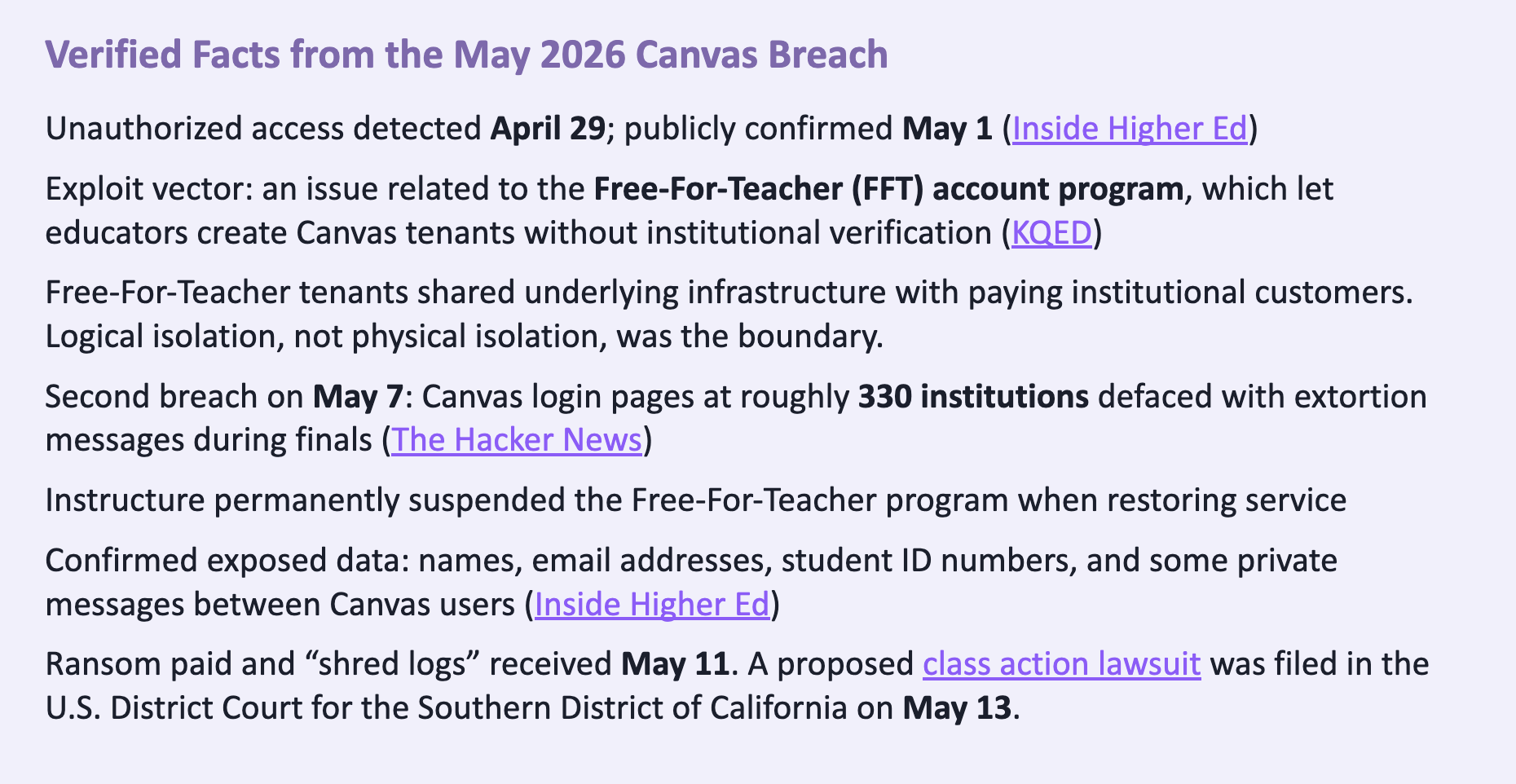
Sit with what that attack vector means. ShinyHunters did not exploit some exotic zero-day. They entered through a free-tier signup pathway that had been operating, with weakened verification, for years. The architecture of multi-tenant SaaS — logical isolation between tenants sharing the same underlying infrastructure — is industry standard. It is also industry-fragile. When the verification gap was exploited, the boundary between unverified teacher accounts and paying institutional customers failed.
This is the architecture of every major SaaS platform higher education depends on. Canvas. Workday. Banner. Salesforce. The Microsoft and Google productivity stacks. Every institution that has migrated systems to a cloud vendor in the last decade has accepted some version of this exposure as the price of operational efficiency. Most have not assessed the exposure deliberately. The Canvas breach is what deliberate assessment looks like — applied in retrospect, under duress, with student data already in criminal hands.
The operational consequence was immediate. When Canvas login pages were defaced on May 7, the University of Washington, UC Riverside, and several thousand other institutions lost simultaneous access during finals. Per CalMatters, California was hit especially hard: all 22 California State University campuses, all 116 California community colleges, six of ten UC campuses, and Stanford were on the affected list. The North Carolina Department of Public Instruction cut access to Canvas across the state’s K-12 system. Durham Public Schools and Wake County Public Schools pulled the plug independently while waiting for clarity that did not arrive for days.
This is what happens when a single vendor’s security posture determines whether 8,809 institutions can hold class.
Vendor Concentration Risk: The Category Higher Ed Boards Have Not Been Governing
Higher education has been quietly concentrating its operational dependencies into a small number of SaaS platforms whose failures cascade across thousands of institutions simultaneously. A single LMS vendor for academic operations. One or two HRIS vendors for personnel data. A handful of student information systems. A short list of identity providers.
The board-level institutional risk register that lists facilities, endowment volatility, enrollment decline, and accreditation status almost never lists “the company that runs our LMS gets breached during finals.” That risk is now demonstrable, current, and unresolved.
The diagnosis is straightforward: Vendor concentration risk is a category financial regulators have governed in banking and insurance for years. It belongs on the higher education risk register now. The Canvas breach is the event that forces the conversation.
Cliff Steinhauer, director of information security and engagement at the National Cybersecurity Alliance, told Inside Higher Ed that Instructure’s ransom payment can create “a dangerous feedback loop where attackers are effectively rewarded for successful breaches.” He is right about the ransom. But the larger feedback loop is structural. Each year higher ed concentrates more operational dependency in fewer vendors, and each year the institutional cost of any single vendor’s breach grows.
The ransom is the symptom. The concentration is the disease.
What Provosts, Presidents, and CIOs Need to Do This Quarter
Four specific moves in the next 90 days.
1. Run a vendor concentration assessment. Identify every SaaS platform on which institutional operations depend. Score each on three dimensions: how many other institutions depend on the same platform, what recovery looks like if the platform is offline for five days, and what data the vendor holds that a breach would expose. The assessment is not theoretical. It is a one-page document the cabinet should be able to read in a meeting.
2. Review the LMS contract specifically. Does the contract include adequate breach notification timelines? What counts as a material breach for purposes of termination or renegotiation? Does it require the vendor to maintain cyber insurance proportional to the exposed data volume? Does it indemnify the institution for downstream harms from a vendor breach? Most LMS contracts were negotiated when the LMS was a content delivery tool, not the operating system of academic life. The contract should reflect what the platform has become.
3. Build an incident response procedure for sustained LMS outage. Existing IT incident response plans almost certainly do not include the scenario of the LMS being down for four to seven days during a high-stakes academic window. ShinyHunters demonstrated that this is real, not hypothetical. The procedure should include pre-authorized faculty communication templates, alternate assessment protocols, deadline extension authority, and a clear chain of decision-making for academic continuity.
4. Brief the board on SaaS dependency exposure. The institutional risk register needs a SaaS dependency line item. Boards have been asked to govern cybersecurity for years; most have done so at the level of “do we have a CISO and a phishing training program.” The Canvas breach forces the conversation up a level. A board that does not know what happens to the institution if its LMS, HRIS, or SIS goes offline for a week is not currently equipped to govern the operational risk it is responsible for.
None of these moves require new technology purchases. None require waiting for federal guidance. They require institutional time and institutional decision-making, which are the resources senior leaders actually control.
The EdGenerative AI Governance Toolkit
Vendor concentration risk is one piece of a larger governance gap. Through my work advising institutions, I developed a policy-neutral, audit-ready AI governance framework mapped to NIST AI RMF, DOJ Title II, FERPA, HECVAT, and ISO/IEC 42001. It is built around Ten Core Components that give institutions a clear path from pilot to practice — and a 90-Day Starter Plan sequenced across three phases (governance charter, risk assessments and procurement safeguards, monitoring and training infrastructure) that produces auditable artifacts boards and accreditors actually want to see
.What’s Ahead
A reminder: the next Use Case Lab is Thursday, May 28 at noon ET — a live working session for paid subscribers where we walk through one real higher-ed AI scenario together. This month’s session will focus on building a vendor concentration assessment for your own institution, using the four-move framework from this issue. If you have been reading as a free subscriber, this is the issue to upgrade on.
Issue #6 will return to the workforce alignment thread from Issue #4 — specifically, how microcredential governance interacts with the SaaS dependency question, and why the institutions building stackable credentials need to think about vendor concentration at the credentialing layer too.
We will also continue documenting how senior leaders are operationalizing AI governance under real pressure — the contract clauses that work, the board conversations that landed, and the governance moves that scaled.
And we will go deep on the next round of federal action: the Workforce Pell launch in July, the accreditor guidance taking shape this summer, and the emerging breach disclosure standards that will shape what “prepared” actually means at the institutional level.
The era of treating LMS choice as a procurement decision is over. The era of treating it as a board-level risk decision has begun.
With gratitude,
Dr. Aviva Legatt
Founder, EdGenerative • Affiliated Faculty, University of Pennsylvania • Forbes Contributor
About Dr. Aviva Legatt
Dr. Aviva Legatt is the founder of EdGenerative, where she advises university boards, presidents, and systems on AI governance, adoption strategy, and microcredentials. She holds a doctorate from the University of Pennsylvania, where she serves as affiliated faculty teaching organizational dynamics. A Forbes Senior Contributor (top 2% designation), she has covered education leadership and interviewed figures from Simone Biles to Adam Grant. She serves on the Montgomery County Advisory Council on Artificial Intelligence for Public Good and is the author of Get Real and Get In (St. Martin’s Press). Her AI Use Cases in Higher Education: A Community Handbook is the open-access resource behind this newsletter.
Paying the ransom is not the story.
The story is that unauthorized execution was allowed to occur against critical educational data systems in the first place.
The industry keeps framing ransomware as a recovery problem, a negotiation problem, an insurance problem, or a public relations problem. That framing starts after leverage has already been created.
The real question is:
Why did an unauthorized actor have the ability to execute against systems containing the data of hundreds of millions of students, faculty, and institutions?
Once attackers achieve execution authority, organizations are left choosing between bad options:
Pay
Restore
Negotiate
Litigate
Explain
None of those are security outcomes.
They’re damage-management outcomes.
The Canvas incident reinforces the larger shift happening across cybersecurity. Attackers increasingly pursue whatever creates leverage - encryption, exfiltration, extortion, operational disruption, or all three.
That is why the conversation needs to move beyond detection and recovery.
Access is not the problem.
Execution authority is.
If unauthorized encryption cannot execute, the ransom conversation never starts.
If unauthorized exfiltration cannot execute, the blackmail leverage disappears.
The future of data protection is not explaining what happened faster.
The future is deterministic control over what is allowed to happen.
No unauthorized execution. No leverage. No ransom. No business disruption.
Jack Fitzpatrick Vice President - Data Protection DataFenz jack@DataFenz.com770-289-6945