
Only 37% of Employers Say You're Preparing Students for AI
The Workforce Alignment Crisis and What Leading Institutions Are Doing About It

Issue #4
Something quietly shifted in the employer landscape over the past year, and most higher ed leaders haven’t noticed yet.
Employers are adopting AI at a pace that makes innovation cycles look quaint. 44% of U.S. businesses now pay for AI tools—up from just 5% in 2023. But here’s the tension: only 37% of these same employers say higher education is actually preparing their future hires with the skills they need. That’s not a minor perception gap. That’s a crisis of institutional relevance.
And it’s directly tied to enrollment, reputation, and your institution’s ability to serve the workforce it claims to prepare.
The Numbers Behind the Alignment Crisis

The WGU Workforce Decoded Report: What Employers Actually Need
The most comprehensive look at this alignment problem comes from the WGU Workforce Decoded Report, which surveyed 3,147 employers in 2026. The findings are both clarifying and sobering:
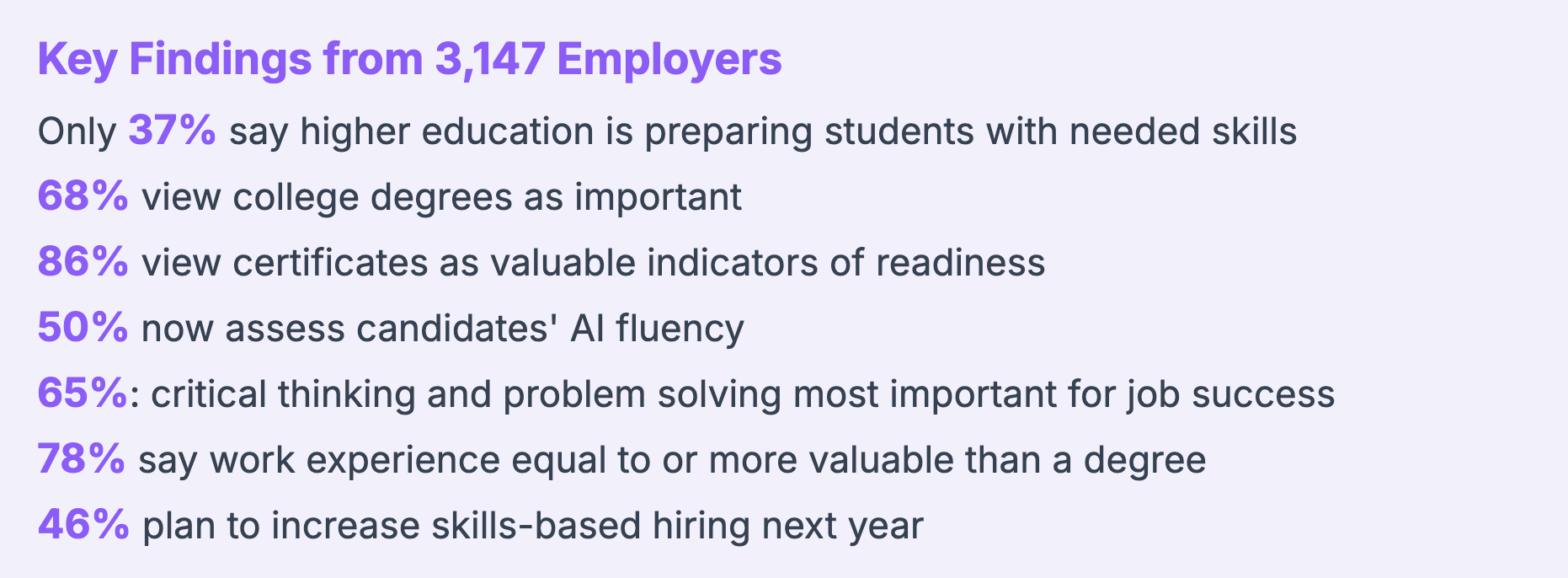
This is the moment when you need to sit with the implications. Employers are clearly asking for AI fluency. Faculty report that graduates aren’t prepared. And institutions have yet to coordinate a systematic response.
The problem isn't that institutions don't care about workforce outcomes. The problem is that they're not designed to move at the speed employers are changing.
To grasp the full scale: up to 80% of the U.S. workforce could have 10% or more of their job tasks exposed to large language models (OECD Skills Outlook 2025). Meanwhile, 63% of faculty report that spring 2025 graduates are not prepared to use AI effectively in the workplace (AAC&U / Elon University survey). And despite all this urgency, 90% of institutions say they’re integrating AI into teaching and research—suggesting that integration and alignment are two entirely different things.
The disconnect is real, measurable, and growing. So what are the institutions that are getting this right actually doing?
Purdue in Practice: Inside the IDA+A Data Science Team
Graduation requirements set the expectation; the harder work is what sits behind them. Purdue’s Institutional Data Analytics + Assessment (IDA+A) team — led by Lead Data Scientist Ian Pytlarz — is where that work becomes operational. Two recent projects Pytlarz shared with me show how a workforce-aligned institution embeds AI into both the back-of-house and the classroom at the same time.
Energy & Utilities predictive modeling. Purdue’s campus E&U operation spends roughly $39 million a year on utilities, and its purchasing priority has historically been reliability over economic efficiency. Pytlarz and Senior Data Scientist Darshan Bhansali built models that forecast campus demand for electricity, steam, and chilled water 96 hours out — refreshed hourly — with consistent accuracy since November 2021 (2.83% MAPE on campus electric, 3.93% total; 7.56% on steam). Paired with Duke Energy’s real-time price data, the system surfaces the lowest-cost operational plan that still meets predicted demand. When the team compared 2022 model recommendations against actuals, the approach pointed to roughly $1.27 million in yearly savings — the kind of measurable AI outcome that moves a board conversation from ‘should we?’ to ‘how fast can we scale it?’
Charlie and the ‘codebook’ approach to LLM evaluation. Charlie is a student writing assistant: faculty upload a grading rubric, students submit drafts, and Charlie returns rubric-grounded feedback. The interesting problem isn’t the tool — it’s the evaluation layer behind it. Pytlarz’s team has built a disciplined evaluation method — an LLM rater, a human subject-matter expert, and a human rater triangulating on whether a prompt change actually made feedback better, with a target of roughly 0.5 Mean Absolute Error between human and LLM judge. Their biggest takeaway, stated plainly on their own slide, is one every academic leader should internalize: “Defining ‘good’ is difficult. Criteria drift — evaluating the output changes the evaluation criteria. Simple word swaps (‘bad,’ ‘good,’ ‘excellent’) are not enough.”
Why this matters for workforce alignment: Purdue’s board set the competency standard, but the IDA+A team provide infrastructure to make it happen. Students graduate having encountered AI as a rubric-grading tutor in their writing classes and as a $1.27M operational savings model inside the institution they attend. That is what ‘prepared’ looks like when it is real — not a syllabus update, but an entire data science function treating LLMs as research artifacts requiring the same calibration, measurement, and criteria-discipline that employers now expect of new hires. With thanks to Ian Pytlarz, Lead Data Scientist, Purdue IDA+A, for sharing the E&U Walkthrough and Charlie & Codebook presentations that informed this section. The work described is his team’s.
The EdGenerative AI Governance Toolkit
The workforce alignment mismatch isn’t just about curriculum — it’s about whether institutions have the governance infrastructure to move quickly enough. Employers are adopting AI faster than most universities can update a syllabus, and the institutions getting it right are the ones with frameworks that connect academic programs to workforce signals in real time. Through my work advising institutions, I developed a policy-neutral, audit-ready governance framework mapped to NIST AI RMF, DOJ Title II, FERPA, HECVAT, and ISO/IEC 42001. It’s built around Ten Core Components that give institutions a clear path from pilot to practice.
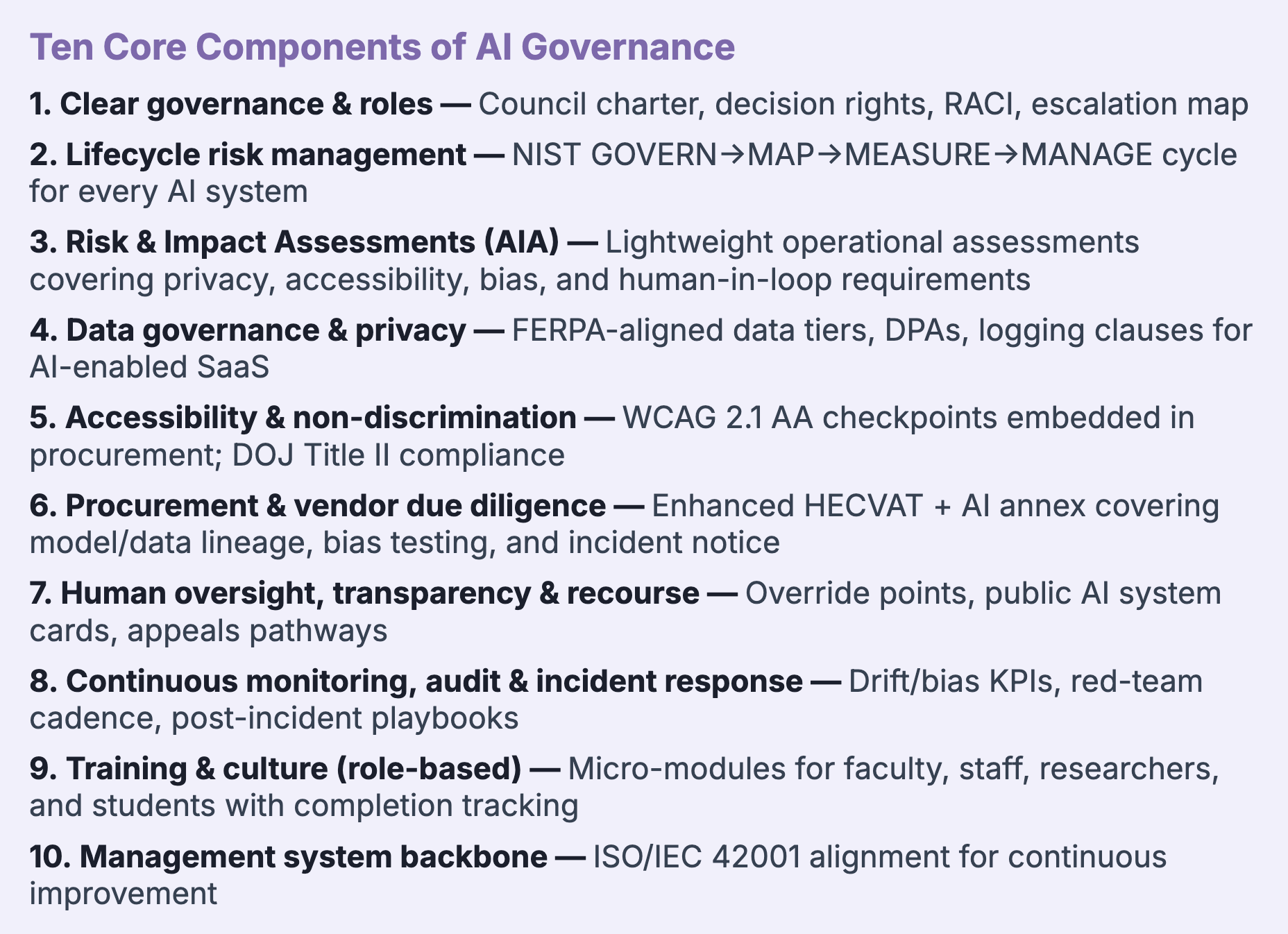
For institutions tackling the workforce alignment crisis profiled in this issue, three components are especially relevant: Component 9 (Training & Culture) provides the infrastructure for role-based AI literacy — not a one-size-fits-all workshop, but differentiated micro-modules that prepare faculty to teach with AI, staff to work alongside it, and students to enter a workforce that expects AI fluency. Component 1 (Clear Governance & Roles) ensures workforce alignment isn’t siloed in career services or the provost’s office, but coordinated across academic affairs, employer partnerships, and institutional research. And Component 6 (Procurement & Vendor Due Diligence) matters more than you might think — the AI tools you bring onto campus for workforce preparation need the same governance rigor as any enterprise system, especially when they touch student data and learning outcomes.
The toolkit includes a 90-Day Starter Plan sequenced across three phases: Q0 (Days 0–14) for publishing a governance charter and drafting your first operational AI assessment; Q1 (Days 15–45) for standing up risk assessments and procurement safeguards; and Q2 (Days 46–90) for launching monitoring, training, and management system infrastructure. It’s designed to produce auditable artifacts at every stage — the kind accreditors and boards actually want to see.

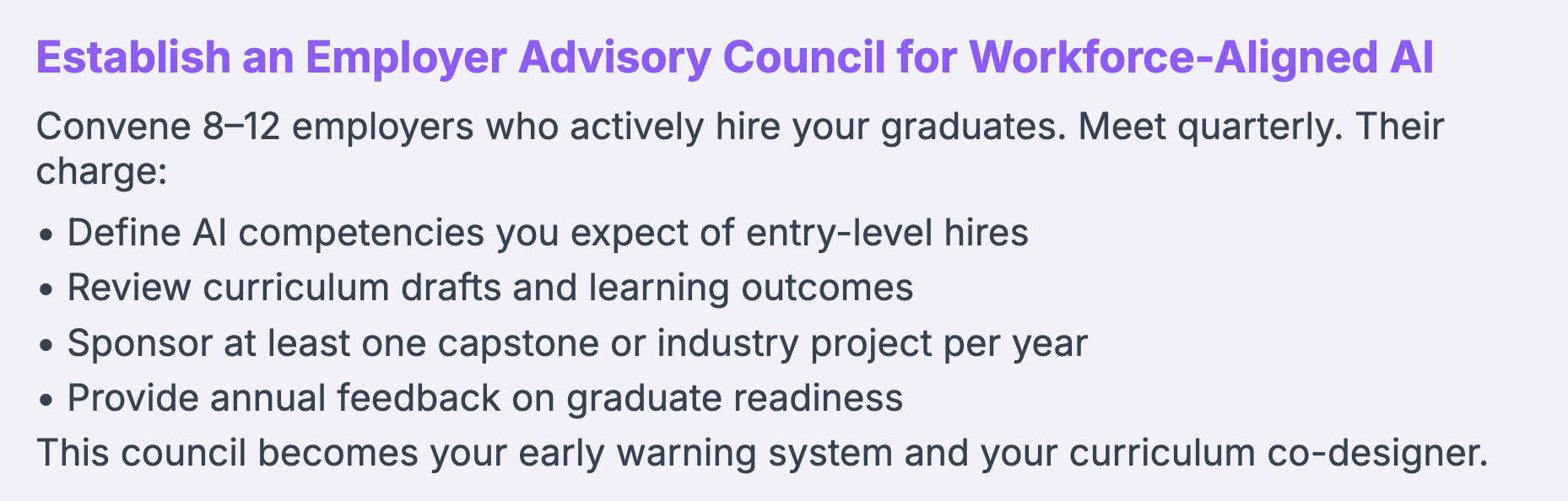
Try This Week
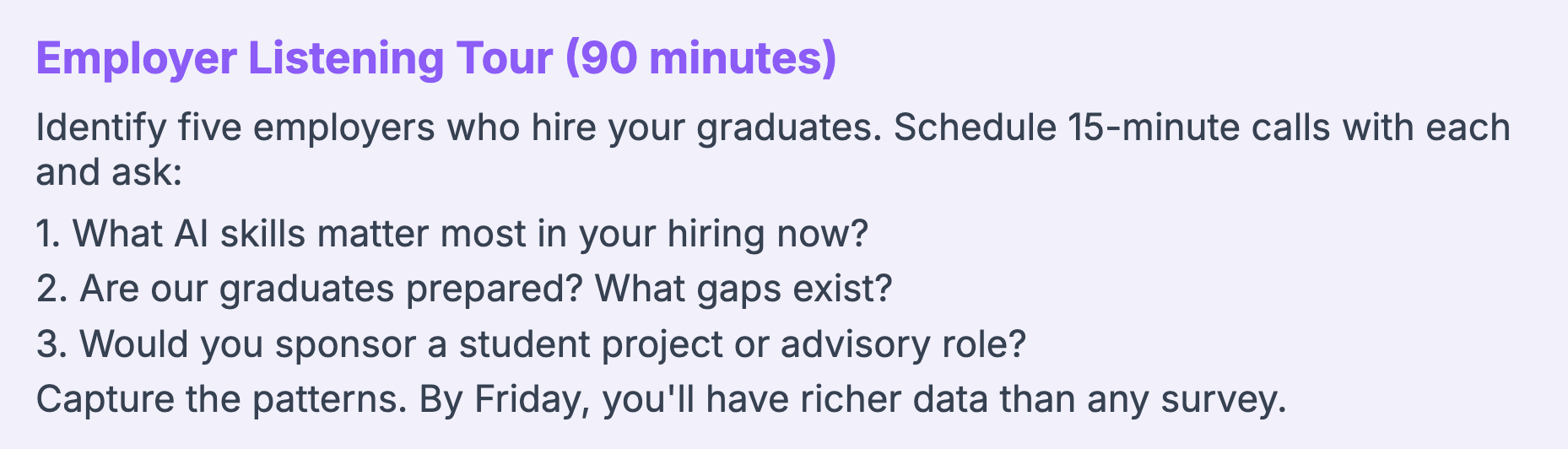
Longer-Term Strategy: Build an Employer Council (60-90 days)
Your 90-Day Implementation Plan
Days 1–30: Discovery and Landscape Scan

Days 31–60: Design Employer-Aligned Competency Framework

Days 61–90: Pilot Integration and Feedback Loop

What’s Ahead
Issue #5 will dive into microcredential governance—how to build stackable, badged credentials that employers recognize and that pair with degrees without creating portfolio chaos.
We’ll also continue documenting case studies from the handbook: how institutions have redesigned curriculum for AI, how they’ve built employer feedback loops, and the governance moves that made it stick.
And we’ll go deep on the federal policy shifts—Workforce Pell, accreditation guidance, and the emerging labor standards that will shape what ‘prepared’ actually means.
With gratitude,
Dr. Aviva Legatt
Founder, EdGenerative • Affiliated Faculty, University of Pennsylvania • Forbes Contributor
About Dr. Aviva Legatt
Dr. Aviva Legatt is the founder of EdGenerative, where she advises university boards, presidents, and systems on AI governance, adoption strategy, and microcredentials. She holds a doctorate from the University of Pennsylvania, where she serves as affiliated faculty teaching organizational dynamics. A Forbes Contributor, she has covered education leadership and interviewed figures from Simone Biles to Adam Grant. She serves on the Montgomery County Advisory Council on Artificial Intelligence for Public Good and is the author of Get Real and Get In (St. Martin’s Press). Her AI Use Cases in Higher Education: A Community Handbook is the open-access resource behind this newsletter.