
The Chatbot That Saved 357 Staff Hours
How the University of Hawaii and Georgia State Built AI Student Support Systems That Work

Issue #3
When I sit with enrollment leaders and student affairs VPs, the same number comes up in almost every conversation: the advising ratio. Your institution has roughly the same number of advisors it had a decade ago. But the complexity your students face — navigating majors, financial aid, course scheduling, career pathways, mental health resources, and policies that change every semester — has tripled. Many students don’t even know where to start asking for help.
This is the paradox at the heart of modern higher education: rising student need meets constrained institutional budgets. In my work advising institutions on AI strategy, I’ve seen this gap widen at every type of institution — from flagship research universities to regional comprehensives. And it’s the reason some institutions are quietly running experiments that are reshaping what student support looks like.
The Larger Landscape: What Staff Need to Know
Before you launch any student support AI initiative, your staff need to understand the bigger picture. Here’s what the data shows about institutional readiness:

Translation: more than half your staff are already using AI, but they don’t know what your policies are. This is a finding I bring into every governance conversation I lead — because it reframes the stakes. Student support AI matters beyond just saving advisor time. It’s a chance to align staff practice with institutional values. When you deploy a governed, institutional AI tool, you’re not just solving a workflow problem. You’re setting a precedent for responsible AI use across campus. And institutions that establish that precedent early have a significant advantage when it comes time to scale.
Case Study 1: University of Hawaii System — Campuswide Chatbot Deployment
The University of Hawaii System serves 10 campuses and 33,000 students across the archipelago. In 2025, they launched an AI chatbot system designed to answer the most common student support questions across all campuses. The results offer a clear lesson in scaled student support.
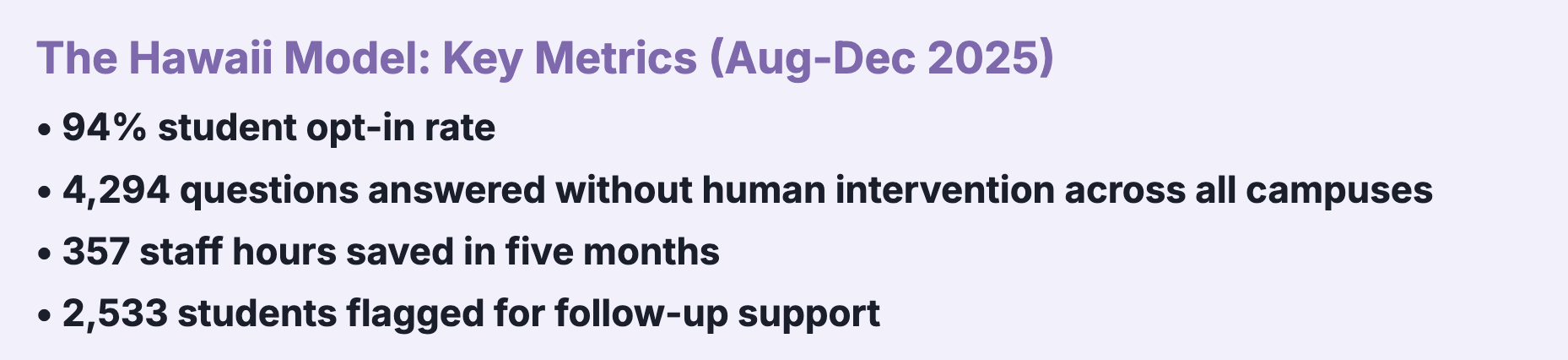
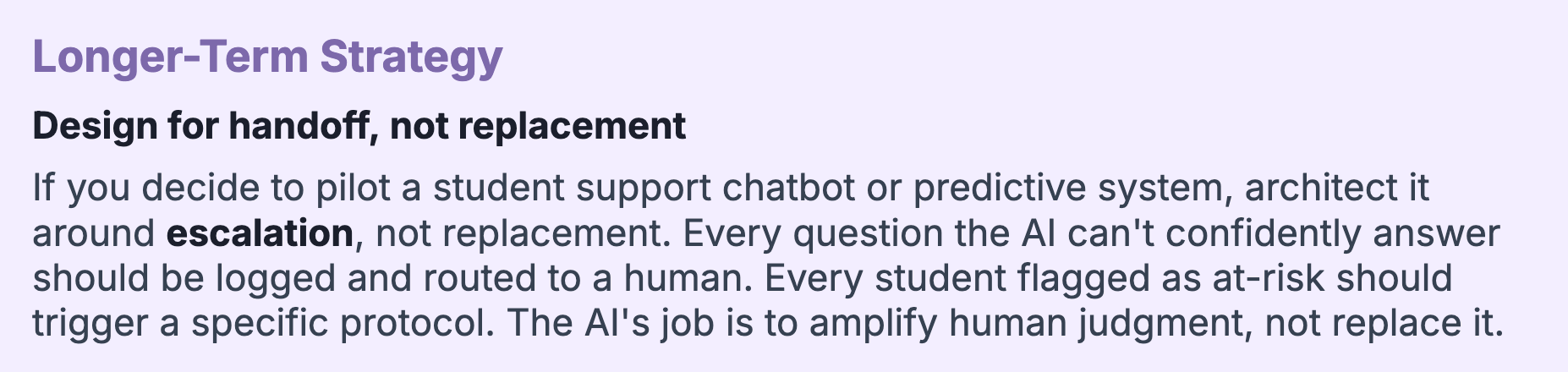
But here’s what made the Hawaii deployment succeed; they didn’t just build a chatbot and turn it loose. They integrated it into existing staff workflows. The system was trained on actual institutional data — course catalogs, financial aid policies, campus calendars — so answers were contextual, accurate, and campus-specific. And critically, it was designed to escalate, not replace. When a student question required human judgment, the chatbot logged it and routed it to the appropriate department.
The 2,533 students flagged for follow-up weren’t a failure. They were precisely identified cases where the chatbot recognized a student needed human support — financial hardship, mental health concern, academic probation — and flagged them for proactive outreach. In other words, the chatbot didn’t just save staff time. It surfaced students who needed help in ways the institution would have missed otherwise.
This is a pattern I’ve seen across every successful student support AI deployment — and one I explicitly build into the governance frameworks I design for institutions: the goal isn’t to eliminate human judgment. It’s to preserve it for the decisions that matter most.
Case Study 2: Georgia State University — Predictive Analytics at Scale
Georgia State University serves 50,000 students and has become a national leader in using AI for retention and enrollment management. But their approach is notably different from Hawaii’s. Where Hawaii deployed reactive support (answering questions), Georgia State built a predictive system designed to intervene before problems emerge.
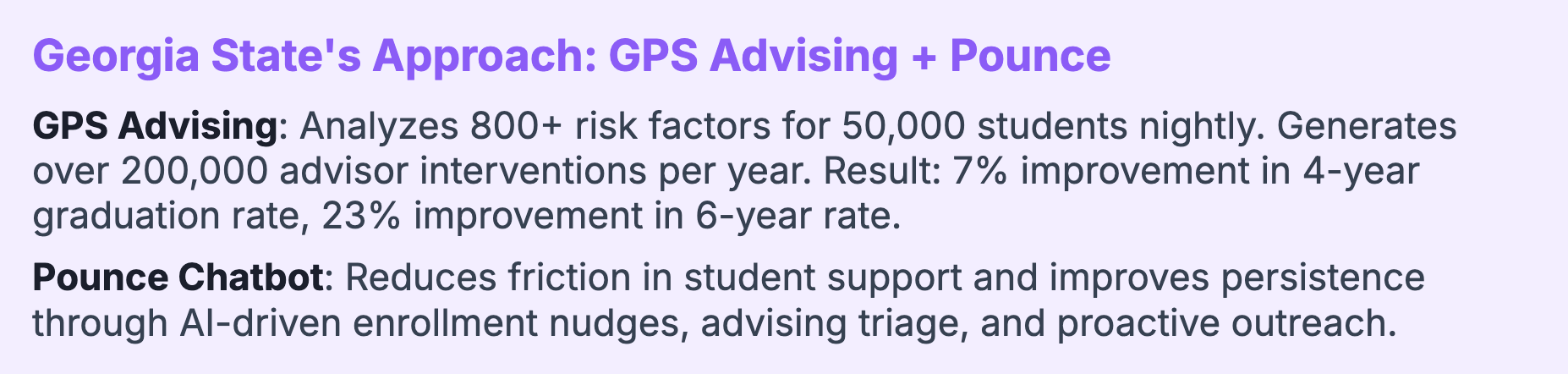
A 23% improvement in 6-year graduation rates means hundreds of additional students graduating who otherwise would have dropped out. And that improvement came not from a new program, but from better information reaching advisors at the moment it matters most.
Georgia State’s system works by feeding advisors timely, relevant risk signals. When an advisor sees that a student is suddenly missing class, when financial aid disbursement hasn’t posted, when a student’s grades drop in a prerequisite course, the system flags it. The advisor reaches out. The student doesn’t disappear. Graduation rates go up.
But — and this is crucial — the system doesn’t make the decision. The advisor does. The AI is doing what it’s actually good at: pattern recognition at scale. The human is doing what only humans can do: understanding context, building relationships, and exercising judgment.
What Others Are Learning: Peer Institutions and Emerging Patterns
Hawaii and Georgia State aren’t alone. A growing number of institutions are experimenting with AI student support. Here’s what the broader landscape looks like:
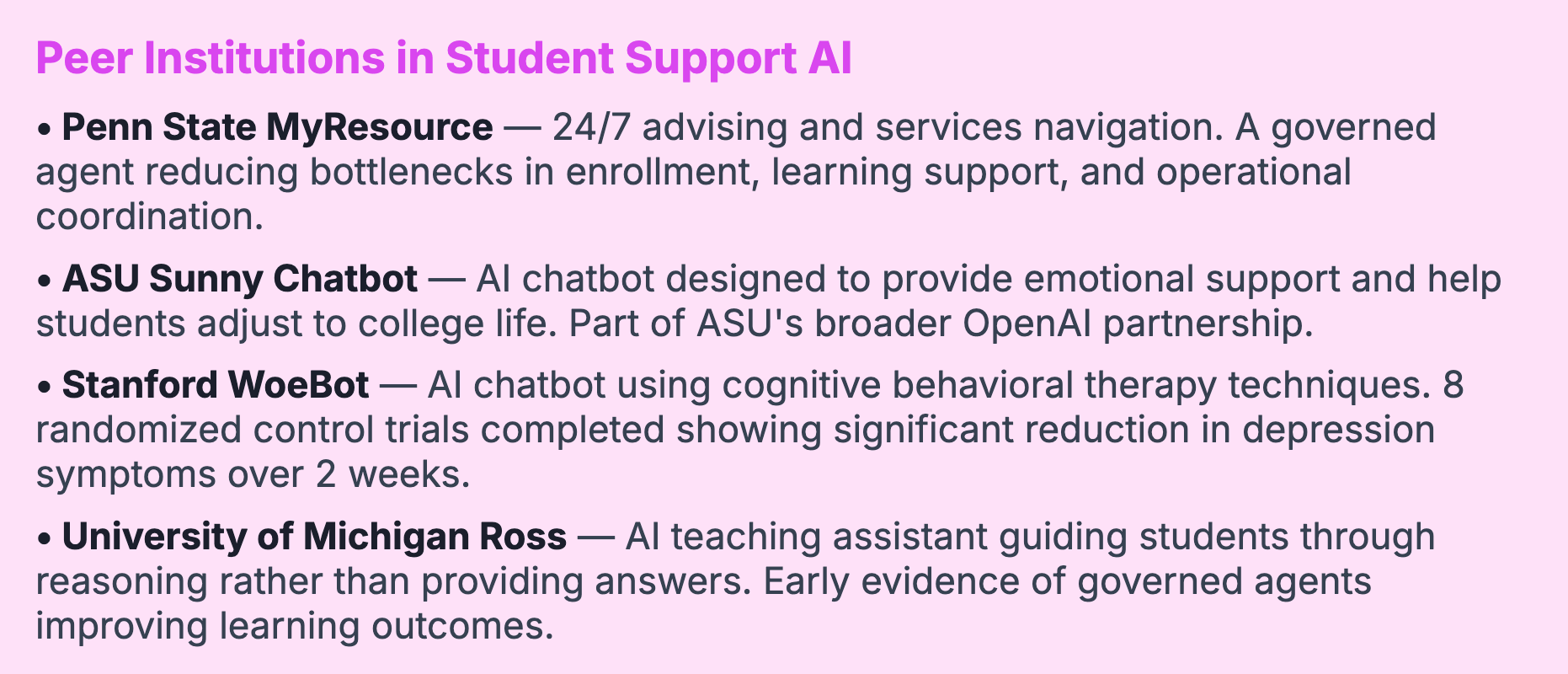
Notice the pattern: every institution that’s getting this right is deploying governed AI. Not just turned loose. Governed. In our governance pilots, we start by mapping exactly these elements: clear goals, stakeholder input, bias monitoring, escalation pathways, and regular audits of what’s working and what isn’t. Institutions that build this infrastructure before scaling find that adoption accelerates — because trust is already in place.
Who Needs to Be in the Room
In my work with advising directors and student affairs leadership, I’ve learned that the stakeholder map is what separates a chatbot pilot that stalls from one that scales. Before you deploy student support AI, you need to know which stakeholders will make or break the implementation. Here’s the map:
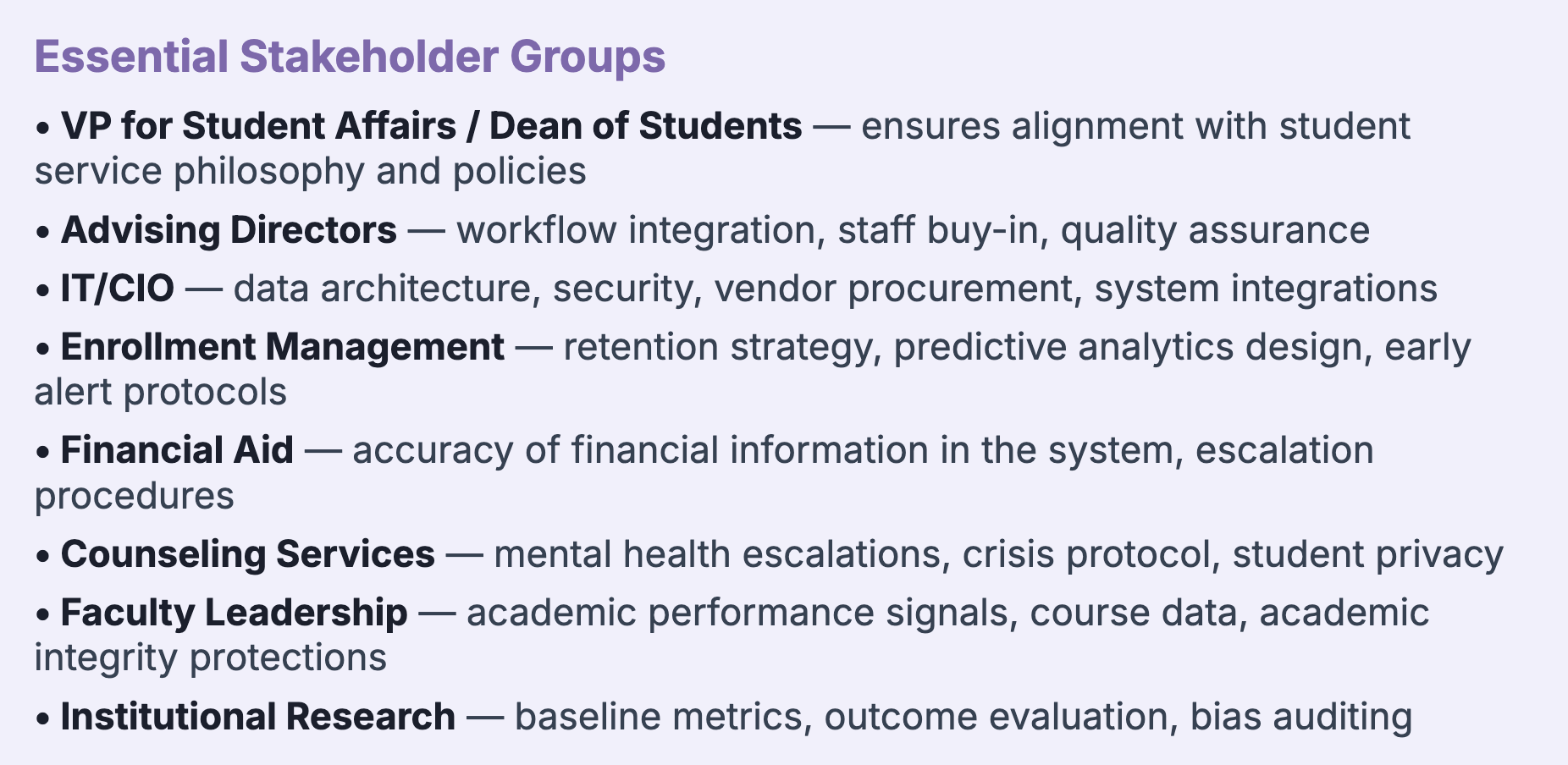
Each of these groups has different priorities, different data security concerns, and different definitions of success. In the governance engagements I lead, I’ve found that the single biggest predictor of pilot success is whether advising staff were involved in the design — not just consulted after the fact. If you bring them all in early, you’ll move faster than you’d expect.
The EdGenerative AI Governance Toolkit
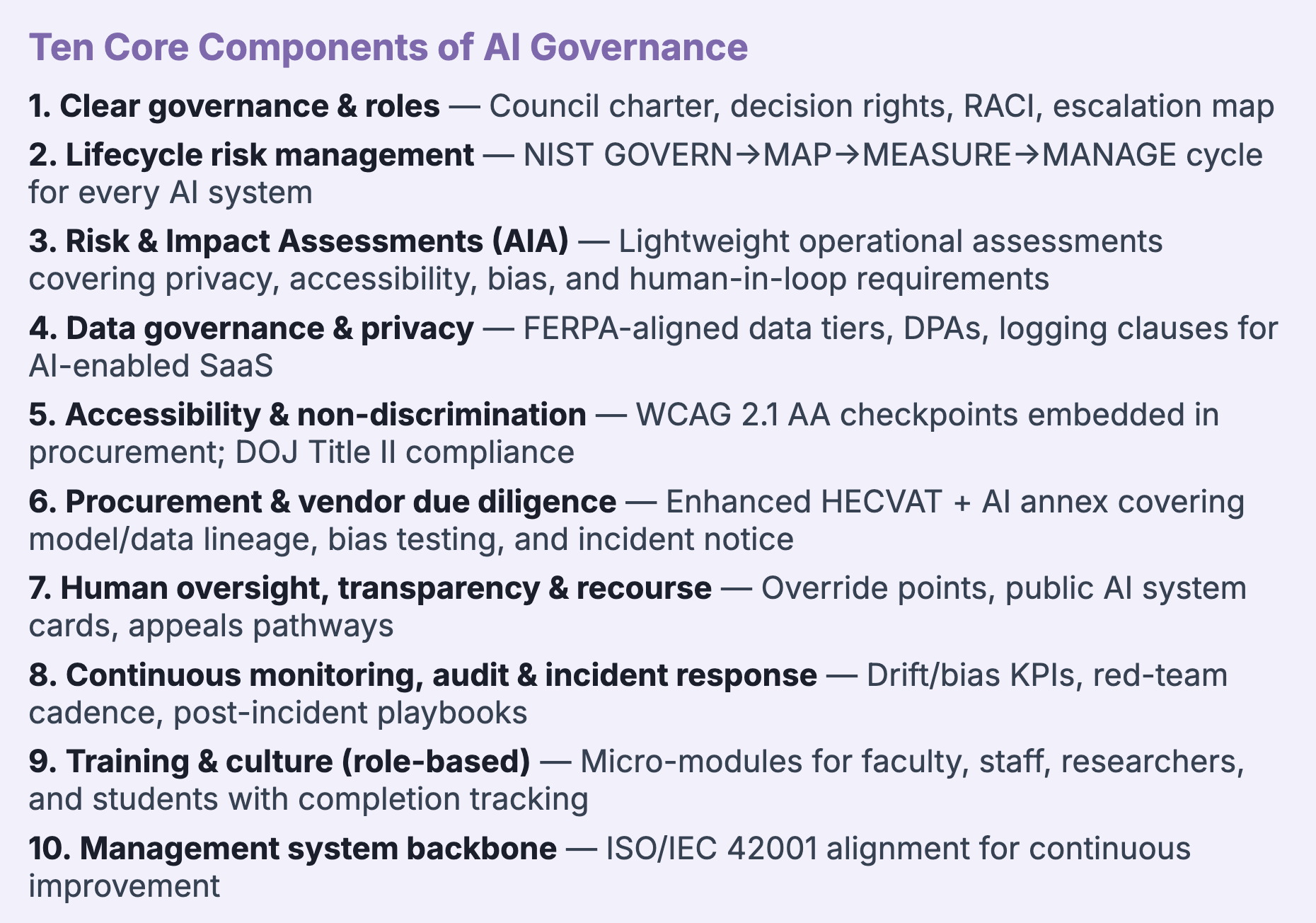
Chatbots and student support systems touch some of the most sensitive data on campus — academic records, mental health disclosures, financial aid status, advising notes. Deploying them without governance infrastructure isn’t just risky; it’s a compliance liability. Through my work advising institutions, I developed a policy-neutral, audit-ready governance framework mapped to NIST AI RMF, DOJ Title II, FERPA, HECVAT, and ISO/IEC 42001. It’s built around Ten Core Components that give institutions a clear path from pilot to practice.

Your Action Plan
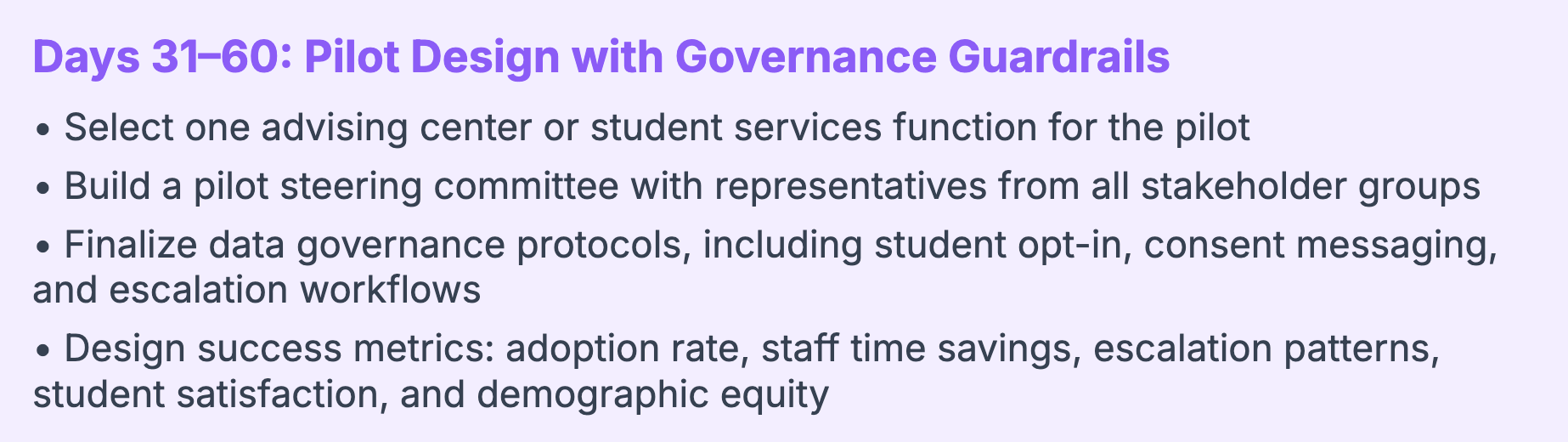
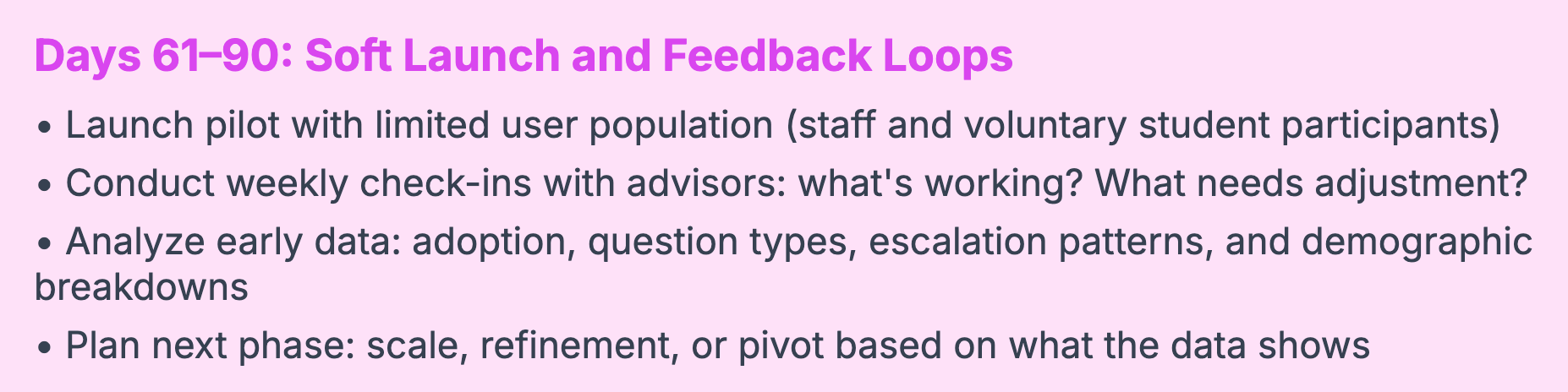
Your 90-Day Implementation Plan
Coming Next in Issue #4

With gratitude,
Dr. Aviva Legatt
Founder, EdGenerative • Affiliated Faculty, University of Pennsylvania • Forbes Contributor
About Dr. Aviva Legatt
Dr. Aviva Legatt is the founder of EdGenerative, where she advises university boards, presidents, and systems on AI governance, adoption strategy, and microcredentials. She holds a doctorate from the University of Pennsylvania, where she serves as affiliated faculty teaching organizational dynamics (Coursera). A Forbes Contributor, recognized among the top 2% of writers, she has covered education leadership and interviewed figures from Simone Biles to Adam Grant. She serves on the Montgomery County Advisory Council on Artificial Intelligence for Public Good and is the author of Get Real and Get In (St. Martin’s Press). Her AI Use Cases in Higher Education: A Community Handbook is the open-access resource behind this newsletter.