
Two New Resources to Help Your Institution Navigate AI
Open, curated handbooks for AI policy benchmarking and validated use cases

Bonus Issue
If you’re a provost, dean, or academic leader trying to figure out where your institution stands on AI—and where it should be heading—you’re not alone. The pace of change in generative AI has outstripped most institutions’ ability to develop thoughtful policy, let alone keep track of what peers are doing or what’s actually working in classrooms.
That’s why I built two open resources designed to give higher education leaders a running start. Today I’m sharing both of them with you as downloadable spreadsheets—living documents that I update regularly as the landscape evolves.
Resource 1: AI Usage Policies in Higher Education Handbook
What it is: A comprehensive, curated database of AI usage policies from colleges, universities, and higher education organizations around the world. Each entry captures the institution, policy type, key provisions, scope, and a direct link to the source document—all independently verified.
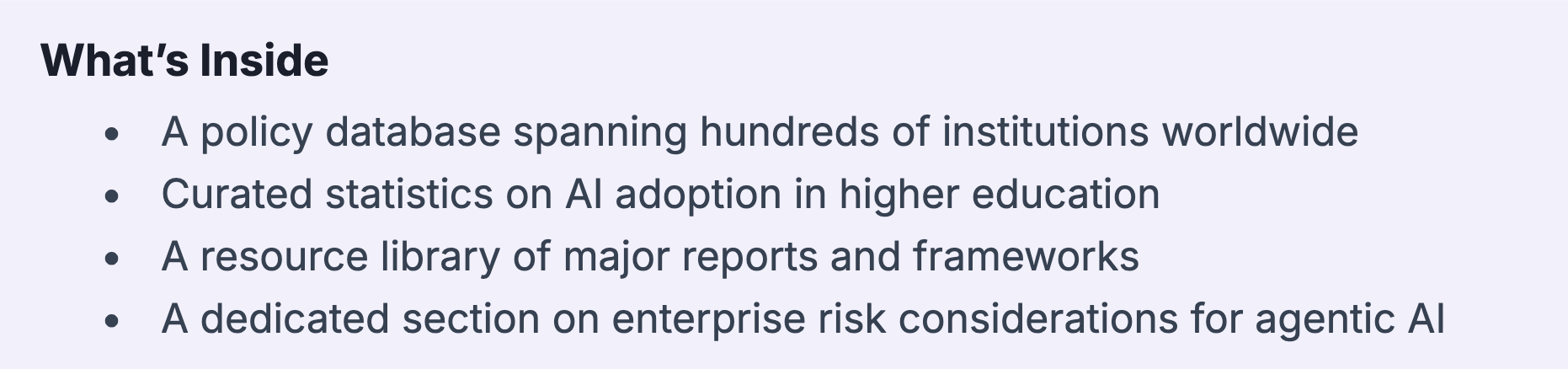
How to use it: Use this resource to benchmark your institution’s AI policy against peers. Filter by policy type to find models that match your governance structure. Share the statistics tab with your board or faculty senate to ground conversations in data rather than speculation. And pay close attention to the enterprise risk section if your institution is exploring AI agents or autonomous tools—this is where the next wave of policy challenges is emerging.
Resource 2: AI Use Cases in Higher Education Handbook
What it is: A curated catalog of validated, real-world AI implementations across higher education. Every entry documents a specific use case, the institution behind it, the AI tools involved, the current status of the initiative, and a source link for further reading.
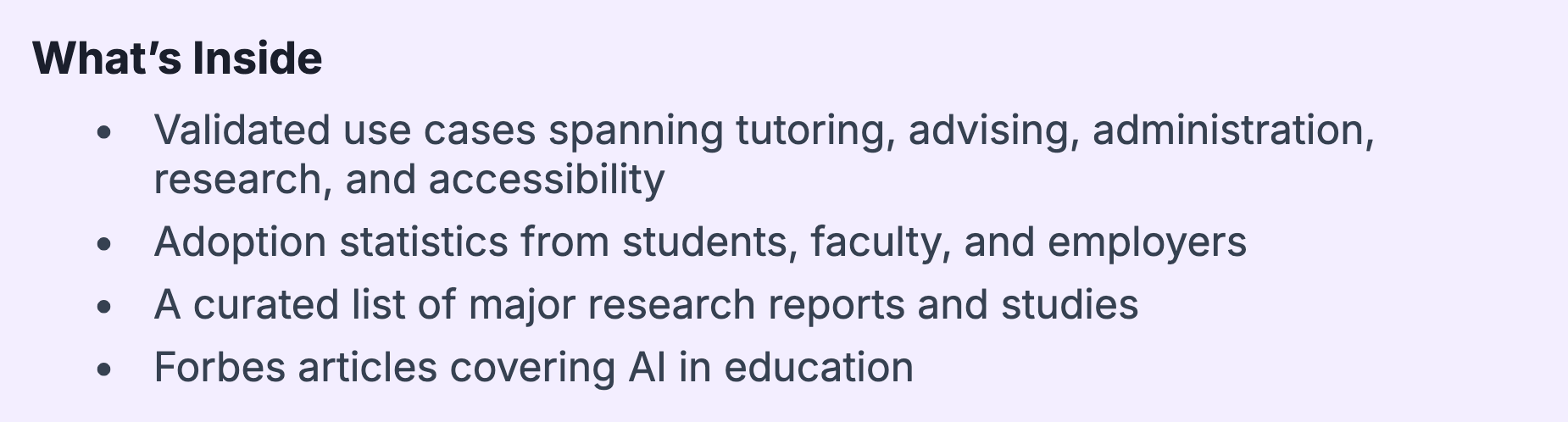
How to use it: If your institution is debating whether to pilot AI in a particular area—say, student advising or course design—start here. Look at what peer institutions have already implemented, what tools they chose, and whether the initiative is still active. This can save your team months of exploratory work and help you build a stronger case for investment by pointing to validated precedents.
Why I Created These Resources
I created these handbooks because I kept having the same conversation with academic leaders: they knew AI was transforming higher education, but they didn’t have a reliable, centralized place to see what was actually happening across the sector. Policy documents were scattered across institutional websites. Use cases lived in conference presentations and press releases. And the gap between what vendors promised and what institutions had actually implemented was enormous.
These resources are my attempt to close that gap. They’re designed to be practical—not theoretical—and to evolve as the field does. I update them regularly, and both include a submission tab so that you can contribute your own institution’s policies or use cases to the growing database.
The most useful resource in a fast-moving landscape is one the community builds together.
Download and Share
Both resources are available as downloadable Excel files attached to this issue. I encourage you to share them with colleagues, reference them in committee discussions, and use them to accelerate your institution’s AI strategy. If you find them valuable, reply to this email and let me know—I’d love to hear how you’re using them.
And if your institution has an AI policy or use case that should be included, use the submission tabs in each handbook to contribute. The more complete these resources become, the more useful they are for everyone.
With gratitude,
Dr. Aviva Legatt
Founder, EdGenerative · Affiliated Faculty, University of Pennsylvania · Forbes Contributor