
Welcome to the Higher Ed AI Playbook
Evidence-Based AI Strategy for Higher Education Leaders
Issue #1
Two years ago, I was sitting across from a university president who told me, with visible frustration: “I know AI is transforming everything. I just don’t know what anyone is actually doing.” It wasn’t that this leader lacked vision. It was that the evidence was scattered — buried in press releases, vendor case studies, and conference anecdotes that rarely translated into a clear picture of what was working, where, and how.
That conversation stayed with me. Because I kept having it — with provosts, board chairs, faculty senate leaders, CIOs, and deans across the country. The same questions surfaced again and again: What are our peers doing with AI? Where’s the evidence? How do we start without betting the whole institution on a pilot?
Those questions are why I built the AI Use Cases in Higher Education: A Community Handbook — and they’re why I’m launching the Higher Ed AI Playbook, the newsletter you’re reading now.
The Numbers That Convinced Me to Act
Let me share the data that made this feel urgent rather than aspirational.

Read those numbers together: students have adopted AI almost universally. Faculty are expanding their use — 93% expect to increase AI use over the next two years.
94% of higher education workers already use AI tools. And yet, only 40% of institutions have policies governing any of it. More than half of staff are using whatever tools they find on their own, with no institutional oversight, no data governance, and no quality assurance.
This isn’t a technology gap. It’s a governance and strategy gap — and it’s widening faster than most institutions realize.
Why This Matters to Me
My path to this work wasn’t linear, but every turn pointed here.
I earned both my master’s and my doctorate at the University of Pennsylvania, where I fell in love with the institution of higher education itself — not just the teaching, but the systems: how decisions get made, how students get served, how a provost’s strategic plan turns into a student’s lived experience. During that time, I worked at the Wharton School, serving on the Freshmen and Transfer Admissions Committees and overseeing the Leadership in the Business World pre-college program.
I later founded Ivy Insight, a college admissions consultancy, and wrote Get Real and Get In (St. Martin’s Press) to help students navigate the process authentically. And then, three years ago, one of my college admissions students everything.
His early college essay drafts were choppy and unfocused. Then, suddenly, polished essays appeared in my inbox — formulaic, well-structured, 100% AI-generated. I was furious. I told him we couldn’t continue unless he stopped. To his credit, he listened, scrapped the drafts, and did the harder work. He got into his dream school.
But the real lesson wasn’t about the essay.
In the months that followed, I kept having versions of that conversation — not just with students, but with the institutions serving them. Administrators were fielding questions about academic integrity policies with no framework to answer them. Faculty were caught between accessibility mandates and AI prohibition. Accreditors were beginning to ask questions that institutional leaders weren’t prepared to address.
A new reality was taking shape. AI was no longer a future issue institutions could monitor from a distance. It was a live governance responsibility — surfacing in accessibility enforcement, accreditation reviews, and federal funding conversations simultaneously, with no playbook in sight.
Institutions needed help. Someone who understood the academic mission, the governance complexity, student needs, and what was actually at stake.
That’s when I stopped asking whether AI belonged in higher education — and started supporting institutions of higher education with what might be the biggest industrial revolution of all time.
That’s why I founded EdGenerative. Through EdGenerative, I now advise boards, presidents, and university systems on AI governance, adoption strategy, and microcredentials. I serve on the Montgomery County Advisory Council on Artificial Intelligence for Public Good, appointed by the Board of Commissioners. And as affiliated faculty at Penn, I continue teaching organizational dynamics via my Coursera courses.
This newsletter is the public-facing extension of all that work. Every issue will aim to bring you the same rigor I bring to boardrooms — grounded in evidence, case studies, and the real governance considerations that determine whether an AI initiative succeeds or stalls.
How the AI Use Cases Handbook Was Born
The inspiration came from Lance Eaton (Substack: AI + Education = Simplified) and his groundbreaking Syllabi Policies for Generative AI Repository — an open, community-driven collection of how educators are handling AI in their courses. Lance proved that the most useful resource in a fast-moving landscape is one the community builds together.
I wanted to create something similar for implementation across teaching, assessment, student support, administration, research, accessibility, workforce development, and governance. The result is the AI Use Cases in Higher Education: A Community Handbook.
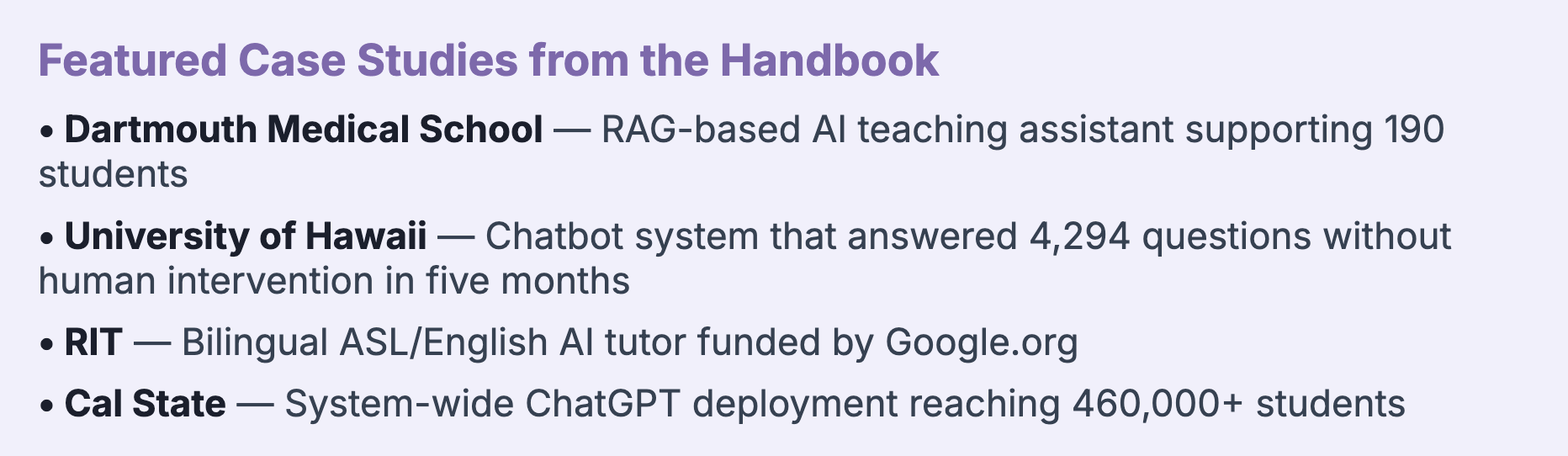
The handbook isn’t a ranking or a scorecard. It’s a living repository of practice. And this newsletter will bring you inside each one.
The Paradox at the Heart of Higher Ed AI
Here’s the tension I want this newsletter to help you navigate:

Both of these are true, and they’re not contradictory. Unstructured, ungoverned AI use can undermine learning. Well-designed, pedagogically informed AI tutoring can double it. The difference isn’t the technology — it’s the strategy, the governance, and the human decisions surrounding it.
That’s exactly what this newsletter is about.
78% of faculty report increases in academic integrity violations since generative AI emerged. Meanwhile, at Georgetown, first-year writing students co-authored the AI policy for their course — distinguishing where AI adds value from where it undermines the learning goal. At Harvard, 100% of physics courses adopted AI-assisted grading, improving feedback quality and informing curriculum design. At Purdue, the board of trustees approved AI working competency as a graduation requirement for every student.
The institutions that are getting this right aren’t choosing between embracing AI and protecting academic integrity. They’re designing systems that do both.
Three Systemic Forces Reshaping the Landscape
No AI initiative exists in a vacuum. Here are the macro forces I’ll be tracking throughout this newsletter, because they affect every decision you’ll make:
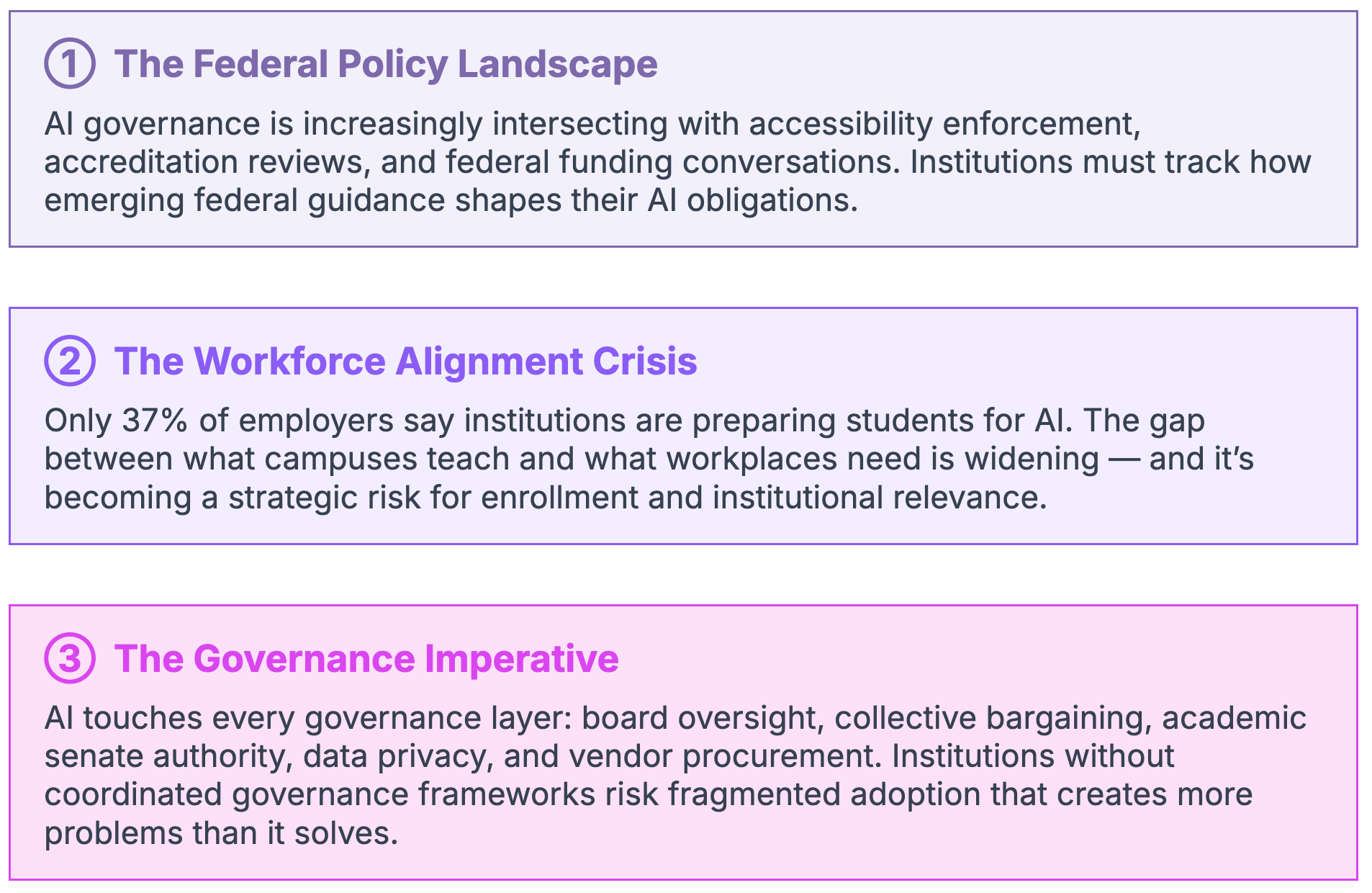
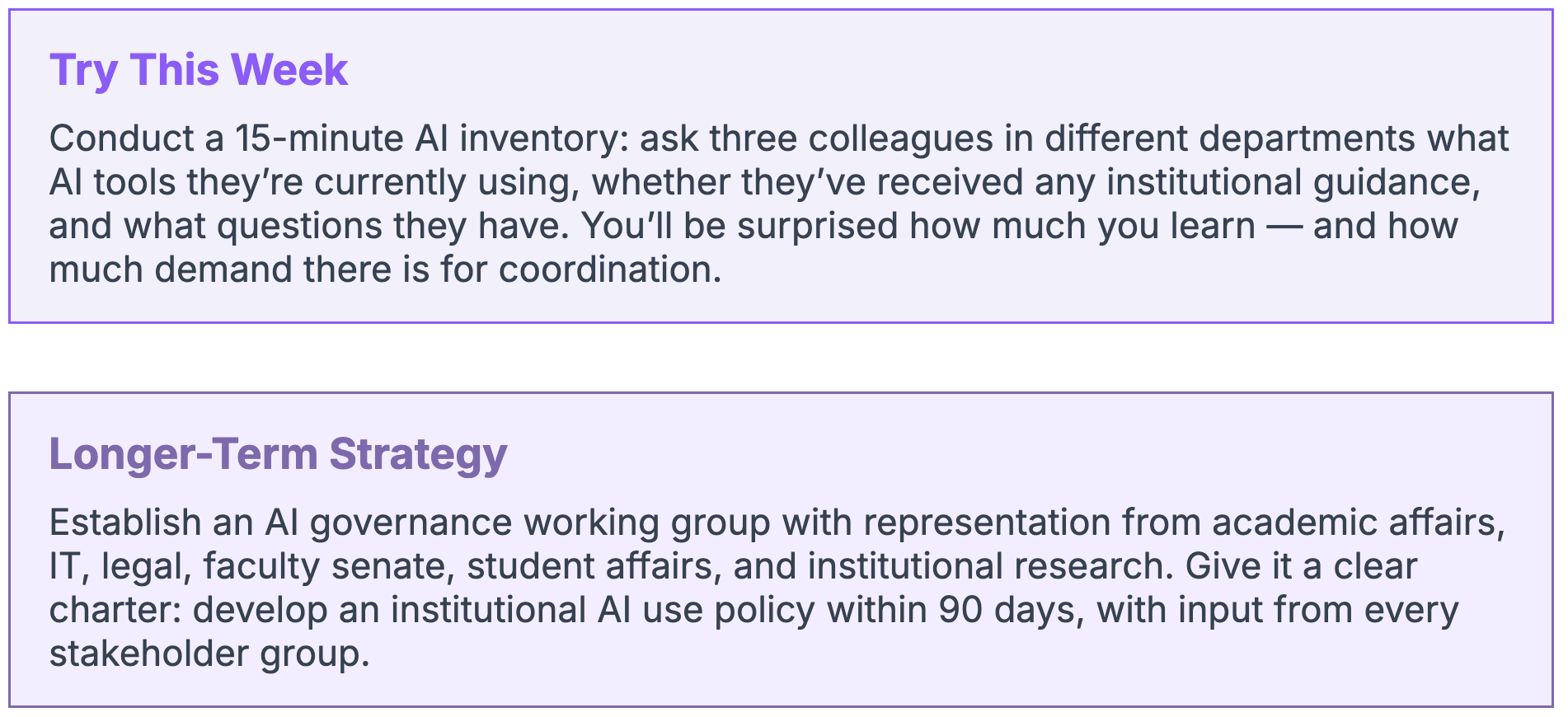
Your First Move: This Week and Beyond
Every issue of this newsletter will give you two practical paths: something you can try this week, and a longer-term strategy that builds institutional capacity over time.
What This Newsletter Will Bring You
Each issue of the Higher Ed AI Playbook will follow a consistent format designed to give you both strategic insight and practical takeaways:
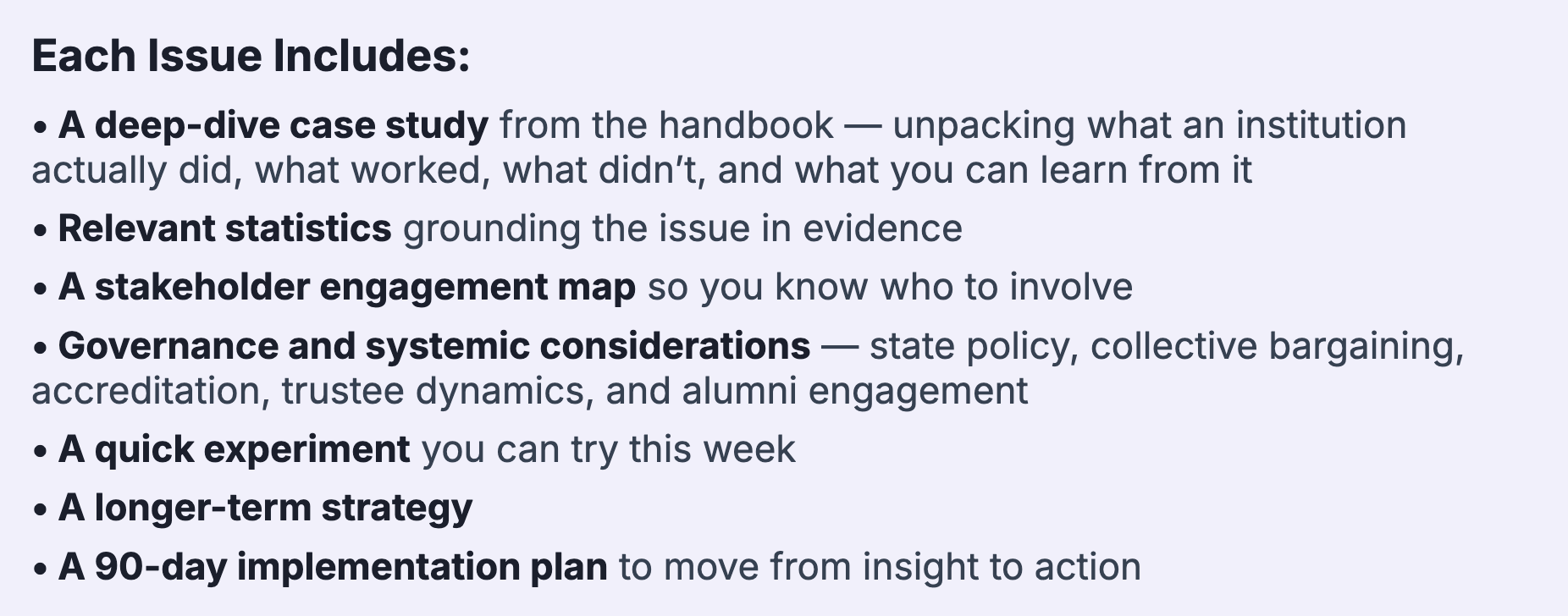
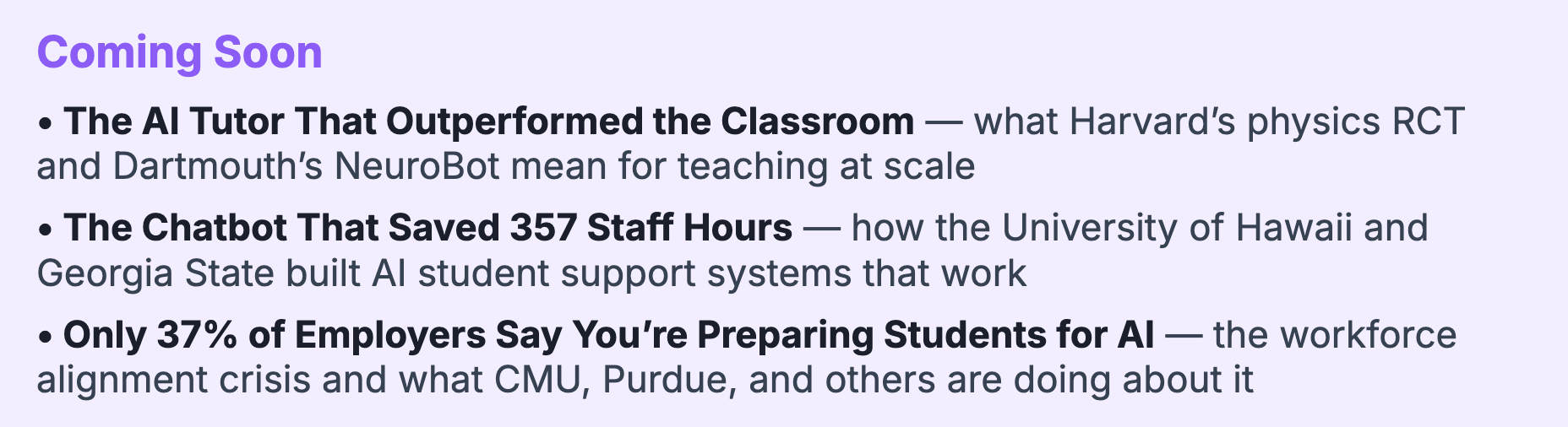
Here’s a preview of topics we’re exploring in upcoming issues:
This newsletter is for the provost who needs evidence before making a budget decision, the CIO who needs a governance framework before signing a vendor contract, the faculty member who wants to experiment responsibly, and the board chair who wants to know what “AI strategy” actually looks like in practice. It’s for anyone in higher education who wants to move forward with both ambition and wisdom.
I’m glad you’re here. Let’s build this together.
With gratitude,
Dr. Aviva Legatt
Founder, EdGenerative · Affiliated Faculty, University of Pennsylvania · Forbes Contributor